Python is powerful, but it is not always the right tool. Slow execution, poor concurrency, and limited mobile support push developers toward python alternatives that are better suited for specific jobs.
Python has real limitations in speed, concurrency, and mobile development. The best python replacement in 2026 are Go, Rust, TypeScript, Kotlin, Swift, Julia, Mojo, C#, Elixir, and more. Each one is mapped to a clear use case below.
In this guide, we’ll cover the 16 best programming languages like Python, what each one does well, where it fits, and when to pick it over Python.
Why Developers Look for Python Alternatives
Python is still one of the most popular programming languages, especially for AI, automation, data science, and backend development. But it has some limitations that push developers toward other languages:
● It is slower than compiled languages for CPU-heavy tasks.
● Its Global Interpreter Lock (GIL) blocks true parallel execution, making it hit a ceiling with
high concurrent connections.
● It does not have native iOS or Android support for on-device applications.
● It may not be the best fit for projects that need stricter typing or lower-level control.
Quick Comparison: Python Alternatives at a Glance
| Language | Speed vs Python | Best Use Case | Learning Curve |
|---|---|---|---|
| JavaScript | Similar | Web, browser AI | Easy |
| Go | Much faster | Cloud backends, APIs | Easy |
| Java | Faster | Enterprise, Android | Moderate |
| Kotlin | Faster | Android, cross-platform | Moderate |
| Rust | Much faster | Systems, WASM, safety | Hard |
| TypeScript | Similar | Web apps, Node.js | Easy |
| Swift | Much faster | iOS, on-device ML | Moderate |
| Dart | Faster | Flutter, cross-platform | Easy |
| Julia | Much faster | Scientific AI, numerics | Moderate |
| C# | Faster | Enterprise, ML.NET | Moderate |
| Elixir | Faster | Real-time, concurrency | Moderate |
| R | Varies | Statistics, data science | Moderate |
| Mojo | Much faster | AI, ML performance | Moderate |
| Zig | Much faster | Systems, embedded | Hard |
| Ruby | Similar | Web apps, prototyping | Easy |
| PHP | Similar | Web, WordPress, CMS | Easy |
Top 16 Python Alternatives In 2026
Besides Python, there are many new languages to learn in the programming sector. Choosing the right framework and the right kind of programming language can be a task. Hence, we have listed various Python alternatives that every programming professional should learn.
1. JavaScript
JavaScript is the only language that runs natively in a browser. According to W3Techs, JavaScript is used by 98.8 percent of all websites as of January 2025.
What It Is Good For
JavaScript handles everything from interactive frontends to server-side backends through Node.js. TensorFlow.js allows machine learning models to run directly in the browser without a server, which is something Python cannot do natively.
When to Pick It Over Python
Pick JavaScript when you are building anything web-facing. It is also a solid choice for lightweight browser-based AI and real-time applications.
Key Strengths
- Runs natively in every browser with no installation
- Node.js makes server-side JavaScript fast and scalable
- TensorFlow.js brings ML directly to the browser
Best for: Web development, full-stack apps, browser-based AI, real-time applications.
function calculateFactorial(number) {
  if (number === 0 || number === 1) return 1;
  let factorial = 1;
  for (let i = 2; i <= number; i++) {
    factorial *= i;
  }
  return factorial;
}

let number = parseInt(prompt("Enter a number:"));
console.log(`The factorial of ${number} is ${calculateFactorial(number)}`);
2. Go

Go is a compiled language from Google. It feels simple to write, close to Python in readability, but runs much faster.
What It Is Good For
Go is the dominant language for cloud-native infrastructure and microservices. It handles high concurrency through goroutines without the complexity of managing threads manually. Dropbox, Uber, and the Kubernetes ecosystem all run on Go.
When to Pick It Over Python
Pick Go when you need a fast backend API, a microservice that handles heavy traffic, or a CLI tool that ships as a single binary with no dependencies.
Key Strengths
- Simple syntax with a short learning curve
- Compiles to a single binary with no runtime dependencies
- Goroutines make concurrent programming clean and efficient
- Much faster than Python for backend and I/O-heavy workloads
Best for: Cloud backends, microservices, CLI tools, high-concurrency APIs.
package main

import "fmt"

func factorial(n int) int {
    if n <= 0 { return 1 }
    return n * factorial(n-1)
}

func main() {
    var num int
    fmt.Print("Enter a number: ")
    fmt.Scan(&num)
    fmt.Printf("Factorial of %d is %d\n", num, factorial(num))
}
3. Java
Java is a mature, object-oriented language that runs on any platform with a Java Virtual Machine. More than 3 billion devices run Java applications today.
What It Is Good For
Java is the language of enterprise systems. Banks, insurers, and large corporations use it to power core infrastructure. In 2026, frameworks like Deeplearning4j and H2O make Java a practical choice for integrating AI into existing enterprise stacks without introducing Python.
When to Pick It Over Python
Pick Java when you are working inside a large enterprise environment, building for Android, or integrating AI into a system that is already Java-based.
Key Strengths
- One of the largest developer communities and talent pools in the world
- Runs on any platform through the JVM
- Mature enterprise AI libraries including Deeplearning4j and H2O
- Spring Boot makes backend development fast and production-ready
Best for: Enterprise applications, Android development, AI in legacy systems, large-scale backends.
public class Main {

    public static void main(String[] args) {
        // Declare two variables to store the numbers
        int num1 = 5;
        int num2 = 7;

        // Calculate the sum of the two numbers
        int sum = num1 + num2;

        // Print the result
        System.out.println("The sum of " + num1 + " and " + num2 + " is: " + sum);
    }
}
4. Kotlin

Kotlin is Google’s official language for Android development. It runs on the Java Virtual Machine and is significantly cleaner to write than Java.
What It Is Good For
Kotlin handles Android development with far less boilerplate than Java. Null safety is built into its type system, which removes a whole category of runtime crashes. Beyond Android, Kotlin Multiplatform allows developers to share business logic across iOS, Android, and the web from a single codebase.
When to Pick It Over Python
Pick Kotlin when you are building Android apps or need a modern JVM language that is as readable as Python but faster and safer at runtime.
Key Strengths
- Fully interoperable with all existing Java libraries
- Official Android development language with full Google support
- Null safety built into the type system prevents common runtime errors
- Kotlin Multiplatform enables cross-platform code sharing
Best for: Android development, cross-platform mobile, server-side Kotlin.
fun main() {
    val name = "John"
    var age = 30
    println("Hello, $name!")
    if (age >= 18) println("$name is an adult.")
    for (i in 1..5) println("Count: $i")
    println("5 + 3 = ${add(5, 3)}")
}

fun add(a: Int, b: Int): Int = a + b
5. PHP
PHP is a server-side scripting language built specifically for web development. It powers over 77 percent of all websites with a known server-side language, including WordPress, Facebook, and Wikipedia.
What It Is Good For
PHP runs directly on the server and generates HTML dynamically. It is deeply integrated with web hosting environments, which makes deployment straightforward with almost any shared hosting provider. Frameworks like Laravel and Symfony make building modern PHP applications fast and well-structured. According to JetBrains’ State of PHP 2024, 61 percent of PHP developers use Laravel regularly.
When to Pick It Over Python
Pick PHP when you are building a content-heavy website, a WordPress-based product, or a web application that needs to run on standard shared hosting without complex server setup. For teams already working in a PHP codebase, it remains a practical and productive choice.
Key Strengths
- Very low barrier to deployment for web projects
- Runs natively on virtually every web hosting environment with zero configuration
- Laravel is one of the most developer-friendly web frameworks available
- Massive ecosystem of CMS platforms, especially WordPress
Best for: WordPress development, content-heavy websites, shared hosting environments, Laravel web apps.
<!DOCTYPE html>
<html>
<head>
    <title>PHP Example</title>
</head>
<body>

<?php
// PHP code starts here
$greeting = "Hello, World!";
$name = "John";

// You can use variables and concatenate strings
$message = $greeting . " My name is " . $name;

// You can also use echo to output content to the web page
echo "<h1>" . $message . "</h1>";

// You can use if statements for conditional logic
if ($name == "John") {
    echo "You are John.";
} else {
    echo "You are not John.";
}
// PHP code ends here
?>

</body>
</html>
6. Rust

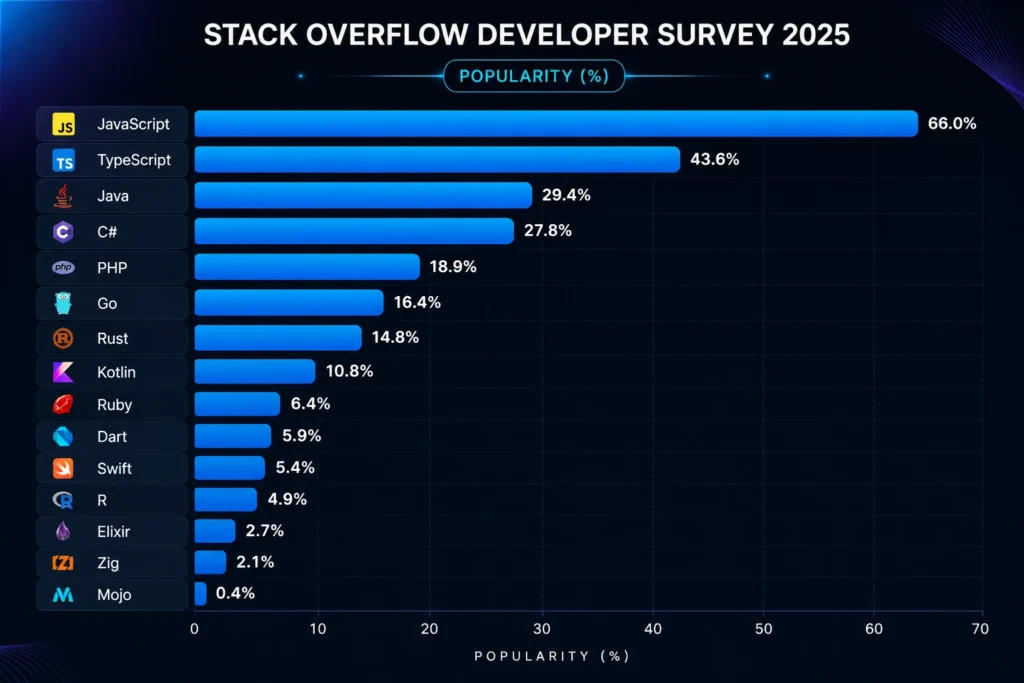
Rust is the most admired programming language in the world according to the Stack Overflow Developer Survey 2025, with 82 percent of users wanting to continue working with it.
What It Is Good For
Rust delivers C-level performance with memory safety guaranteed at compile time. There is no garbage collector. Instead, the ownership system catches memory bugs before the code ever runs. Google, Microsoft, Amazon, and the Linux kernel project all use Rust for critical systems work.
When to Pick It Over Python
Pick Rust when performance and memory safety are both non-negotiable. It is especially strong for systems software, WebAssembly, and any workload where Python is simply too slow.
Key Strengths
- Active community and a growing ecosystem through Cargo
- Memory safety guaranteed at compile time with no garbage collector
- Execution speed comparable to C and C++
- Leading language for WebAssembly targets in 2026
Best for: Systems programming, embedded development, WebAssembly, performance-critical backends.
// The main function is the entry point of a Rust program
fn main() {
    // Printing to the console
    println!("Hello, world!");

    // Variables are immutable by default
    let x = 5;
    println!("The value of x is: {}", x);

    // Variables can be made mutable with the 'mut' keyword
    let mut y = 10;
    println!("The value of y is: {}", y);

    // You can reassign a mutable variable
    y = 20;
    println!("Now, the value of y is: {}", y);

    // Rust has strong, static typing
    let z: f64 = 3.14; // Explicit type annotation

    // Control flow with if-else
    if z > 4.0 {
        println!("z is greater than 4");
    } else {
        println!("z is not greater than 4");
    }

    // Loops: 'for' loop (with a range)
    for i in 0..5 {
        println!("Count: {}", i);
    }

    // Functions
    let result = add_numbers(x, y);
    println!("The result of adding x and y is: {}", result);
}

// Define a function that adds two numbers and returns the result
fn add_numbers(a: i32, b: i32) -> i32 {
    // The last expression in a function is returned
    a + b
}
7. Typescript
TypeScript is a statically typed superset of JavaScript developed by Microsoft. In 2026, it is the default choice for any serious JavaScript project.
What It Is Good For
TypeScript adds static types to JavaScript, catching bugs at compile time rather than at runtime. Angular, Vue, and React all use TypeScript as their primary language today. For large codebases, TypeScript makes refactoring safe and predictable.
When to Pick It Over Python
Pick TypeScript when you are building web applications, Node.js APIs, or any frontend project where code quality and maintainability matter. It is the most natural next language for Python developers entering web development.
Key Strengths
- De-facto standard for production web applications in 2026
- Static typing catches bugs before they reach production
- Full compatibility with every npm package
- Outstanding tooling support in VS Code
Best for: Web applications, Node.js backends, large-scale frontend development.
// Define a variable with a specific type
let greeting: string = "Hello, TypeScript!";

// Define a function with typed parameters and return value
function sayHello(name: string): string {
    return `Hello, ${name}!`;
}

// Call the function
const message = sayHello("Alice");
console.log(message); // Output: Hello, Alice!

// Define an interface to describe the shape of an object
interface Person {
    name: string;
    age: number;
}

// Create an object that adheres to the Person interface
const person: Person = {
    name: "Bob",
    age: 30,
};

// Define an array with a specific type of elements
const numbers: number[] = [1, 2, 3, 4, 5];

// Use a for...of loop to iterate through the array
for (const num of numbers) {
    console.log(num); // Output: 1, 2, 3, 4, 5
}

// Use optional and default parameters in a function
function greetPerson(name: string, greeting?: string = "Hello") {
    console.log(`${greeting}, ${name}!`);
}

greetPerson("Eve"); // Output: Hello, Eve!
greetPerson("Dave", "Hi"); // Output: Hi, Dave!
8. Swift
Swift is Apple’s language for building iOS and macOS applications. It is compiled, fast, and designed for the Apple ecosystem.
What It Is Good For
Swift is the go-to language for iOS development. In 2026, it has also become important for on-device machine learning through Apple’s Core ML framework, which lets developers run AI models directly on iPhone hardware without any network call. Python cannot replicate this natively on mobile.
When to Pick It Over Python
Pick Swift when you are targeting the Apple platform — iPhone, iPad, Mac, or Apple Watch. It is also the right choice for any project involving on-device AI on Apple hardware.
Key Strengths
- Consistently ranked among the most loved languages by developers
- Fastest language for building iOS and macOS applications
- Core ML makes on-device AI development straightforward
- Null safety built into the type system for reliable code
Best for: iOS app development, macOS apps, on-device machine learning.
// Function to calculate factorial
func factorial(_ n: Int) -> Int {
    if n == 0 {
        return 1
    } else {
        return n * factorial(n - 1)
    }
}

// Input a number
let number = 5

// Calculate and print the factorial
let result = factorial(number)
print("The factorial of (number) is (result)")
9. Dart

Dart is Google’s language for building cross-platform applications. It powers the Flutter UI framework.
What It Is Good For
A single Dart codebase compiles to iOS, Android, web, and desktop. Flutter is the most popular cross-platform mobile framework in 2026, and Dart is the language behind it. Its async/await support feels very similar to Python’s own async model.
When to Pick It Over Python
Pick Dart when you need to ship on multiple platforms from a single codebase. It is the most practical choice for mobile and cross-platform product teams that want to avoid maintaining separate iOS and Android codebases.
Key Strengths
- Strong async support with an async/await model similar to Python
- Flutter enables one codebase to target iOS, Android, web, and desktop
- Clean syntax that is easy to pick up for Python developers
- AOT compilation produces fast native binaries for production
Best for: Cross-platform mobile with Flutter, web apps, desktop applications.
// This is a Dart program that prints a message to the console.

// Define a function called 'main'. This is the entry point of our program.
void main() {
  // Use the 'print' function to display a message on the console.
  print("Hello, World!");

  // Variables can be declared using 'var', 'int', 'double', 'String', etc.
  var name = "Alice";
  int age = 30;
  double height = 5.8;
  String city = "New York";

  // Dart supports string interpolation with the '$' symbol.
  print("$name is $age years old and lives in $city.");

  // You can also perform basic operations.
  int x = 10;
  int y = 5;
  int sum = x + y;
  print("The sum of $x and $y is $sum.");

  // Conditional statements (if-else) can be used for decision-making.
  if (age >= 18) {
    print("$name is an adult.");
  } else {
    print("$name is a minor.");
  }

  // Dart also supports loops like 'for' and 'while'.
  for (int i = 1; i <= 5; i++) {
    print("Count: $i");
  }

  // Lists are used to store collections of values.
  List<String> fruits = ["Apple", "Banana", "Orange"];
  print("Fruits: $fruits");

  // Functions can be defined for reusable code.
  int multiply(int a, int b) {
    return a * b;
  }

  int result = multiply(3, 4);
  print("3 * 4 = $result");
}
10. Julia
Julia is a high-performance language built specifically for scientific computing, numerical analysis, and AI research.
What It Is Good For
Julia solves the problem Python developers know well: you prototype in Python, then rewrite slow parts in C for speed. Julia eliminates this by offering Python-like syntax while compiling to native machine code that rivals C in benchmarks. It is the fastest-growing python alternative in data science and AI research in 2026.
When to Pick It Over Python
Pick Julia when your work involves heavy numerical computation, scientific AI, climate modelling, bioinformatics, or quantitative finance where Python’s speed becomes a real constraint.
Key Strengths
- Execution speed comparable to C for numerical workloads
- Eliminates the need to rewrite Python prototypes in a faster language
- Built-in support for parallel and distributed computing
- Interoperates smoothly with Python, R, and C libraries
Best for: Scientific computing, AI research, numerical analysis, quantitative finance.
# Define a function to calculate the factorial of a number
function factorial(n)
    if n == 0
        return 1
    else
        return n * factorial(n - 1)
    end
end

# Get user input for the number
println("Enter a number:")
n = parse(Int, readline())

# Calculate and display the factorial
result = factorial(n)
println("The factorial of $n is $result")
11. C# (.NET)
C# is Microsoft’s primary programming language for the .NET ecosystem. It is modern, fast, and well-suited for both enterprise and AI work. Notably, C# was named TIOBE’s Programming Language of the Year for 2025 after gaining 2.94 percentage points year-over-year.
What It Is Good For
C# is the right choice for enterprise teams that already run .NET infrastructure and want to add AI without introducing Python. ML.NET supports classification, regression, clustering, and anomaly detection, and integrates with TensorFlow and ONNX models. C# is also the scripting language for the Unity game engine.
When to Pick It Over Python
Pick C# when you are working in a .NET environment, building enterprise software, or developing with Unity. It gives you Python-like readability with significantly better runtime performance.
Key Strengths
- ML.NET enables full machine learning workflows inside the .NET ecosystem
- Strong async and parallel programming support built in
- Unity game engine uses C# for all scripting and AI logic
- Excellent tooling through Visual Studio and VS Code
Best for: Enterprise applications, Unity development, AI with ML.NET, cloud-native .NET services.
using System;

class Program {
    static int Factorial(int n) {
        if (n <= 1) return 1;
        return n * Factorial(n - 1);
    }

    static void Main() {
        Console.Write("Enter a number: ");
        int num = int.Parse(Console.ReadLine());
        Console.WriteLine($"The factorial of {num} is {Factorial(num)}");
    }
}
12. Elixir
Elixir is a functional language built on the Erlang virtual machine (BEAM). It is designed specifically for scalable, fault-tolerant systems.
What It Is Good For
Elixir can run millions of lightweight concurrent processes on a single machine. This makes it the language of choice for real-time systems — chat platforms, live APIs, and anything that needs to handle thousands of simultaneous connections with predictable low latency. According to the Stack Overflow Developer Survey 2025, Elixir is the third most admired programming language with a 66 percent admiration rate.
When to Pick It Over Python
Pick Elixir when Python’s GIL is a genuine bottleneck and you need to handle extreme concurrency without the complexity of managing threads manually. The Phoenix framework makes real-time web applications straightforward to build.
Key Strengths
- BEAM virtual machine handles millions of concurrent processes efficiently
- Fault tolerance built into the language through supervisor trees
- Phoenix framework makes real-time web development simple
- Clean, readable syntax approachable for Python developers
Best for: Real-time applications, chat systems, high-concurrency APIs, distributed systems.
defmodule Factorial do
  def calculate(0), do: 1
  def calculate(n) when n > 0, do: n * calculate(n - 1)
end

IO.puts "Enter a number:"
n = IO.gets("") |> String.trim() |> String.to_integer()
IO.puts "The factorial of #{n} is #{Factorial.calculate(n)}"
13. R

R is a language built specifically for statistical computing and data visualisation. It is widely used in research, academia, and data science teams that need deeper statistical tools than Python offers.
What It Is Good For
R dominates in biostatistics, clinical research, financial modelling, and exploratory data analysis. Its CRAN package repository has thousands of specialised statistical packages. According to the Kaggle State of Data Science 2024 Survey, approximately one in four data scientists still use R as a primary language.
When to Pick It Over Python
Pick R when your work is primarily statistical and you need capabilities that Python’s scipy and statsmodels libraries do not fully cover. It is also the standard in academic research environments where reproducible analysis documents matter.
Key Strengths
- Deeper statistical capabilities than Python for specialist research work
- ggplot2 is the most powerful data visualisation library available
- R Markdown enables reproducible, publishable research documents
- Large and active community of statisticians and researchers
Best for: Statistical modelling, bioinformatics, financial analysis, academic research.
factorial_custom <- function(n) {
  if (n == 0) return(1)
  return(n * factorial_custom(n - 1))
}

n <- as.integer(readline(prompt = "Enter a number: "))
cat("The factorial of", n, "is", factorial_custom(n), "\n")
14. Mojo

Mojo is a new programming language from Modular Inc. that is specifically designed as a high-performance Python alternative for AI workloads.
What It Is Good For
Mojo is a superset of Python, which means existing Python code runs inside Mojo without any changes. On top of that, Mojo adds low-level capabilities like manual memory management and SIMD operations that make it dramatically faster than Python for AI inference and GPU workloads. Think of it as Python designed for AI hardware.
When to Pick It Over Python
Pick Mojo when standard Python is too slow for your AI pipeline and you do not want to rewrite everything in C++. Because Mojo is Python-compatible, you can introduce it into an existing project one file at a time with minimal risk.
Key Strengths
- Full Python compatibility means existing Python code runs without changes
- Dramatically faster than Python for AI and numerical workloads
- Optional progressive type system similar to how TypeScript adds types to JavaScript
- Built for GPU and AI hardware acceleration targets
Best for: AI inference, GPU workloads, performance-critical ML pipelines, production AI systems.
# Mojo syntax is a superset of Python
fn factorial(n: Int) -> Int:
    if n == 0:
        return 1
    return n * factorial(n - 1)

fn main():
    let number: Int = 5
    let result = factorial(number)
    print("The factorial of", number, "is", result)
15. Zig

Zig is a modern systems programming language designed as a cleaner alternative to C and C++.
What It Is Good For
Zig gives developers full control over memory without a garbage collector. Unlike C, it has explicit error handling that the compiler checks, which removes a large class of subtle bugs. Its first-class cross-compilation support makes it very practical for embedded and firmware development targeting different hardware architectures.
When to Pick It Over Python
Pick Zig when you are working at the systems level — embedded firmware, operating system components, or any domain where you need full control over hardware resources and Python is simply not an option.
Key Strengths
- No hidden memory allocations and no garbage collector make Zig very predictable
- Compile-time-checked error handling reduces runtime surprises
- Excellent cross-compilation support for multiple hardware targets
- Direct interoperability with C libraries and the entire C ecosystem
Best for: Embedded systems, firmware, operating system components, cross-platform systems software.
const std = @import("std");

fn factorial(n: u64) u64 {
    if (n == 0) return 1;
    return n * factorial(n - 1);
}

pub fn main() !void {
    const stdout = std.io.getStdOut().writer();
    const number: u64 = 5;
    try stdout.print("The factorial of {} is {}\n", .{ number, factorial(number) });
}
16. Ruby
Ruby is a high-level language with a syntax that reads almost like plain English. It is one of the programming languages most similar to Python in developer experience.
What It Is Good For
Ruby on Rails is one of the most productive web frameworks ever built. GitHub, Shopify, and Airbnb all started on Rails. In 2026, Ruby remains a strong choice for web application development and rapid prototyping where getting to production fast matters more than raw performance.
When to Pick It Over Python
Pick Ruby when you are building a web product and want a framework that handles most of the heavy lifting through convention over configuration. It is particularly good for early-stage products where iteration speed is the priority.
Key Strengths
- Ruby on Rails enables very fast web application development
- Clean, expressive syntax with a focus on developer happiness
- Strong convention over configuration philosophy reduces decision fatigue
- Active and welcoming open-source community
Best for: Web development with Rails, API backends, rapid prototyping.
def factorial(n)
  return 1 if n == 0
  n * factorial(n - 1)
end

print "Enter a number: "
number = gets.chomp.to_i
puts "The factorial of #{number} is #{factorial(number)}"
How to Choose the Right Python Alternative
Go by Use Case
| You need… | Pick this |
|---|---|
| Fast backend API or microservice | Go |
| Systems programming with memory safety | Rust |
| iOS or on-device ML | Swift |
| Android development | Kotlin |
| Cross-platform mobile app | Dart |
| Web frontend or full-stack | TypeScript |
| Scientific computing or numerical AI | Julia |
| AI performance on GPU | Mojo |
| Enterprise .NET AI | C# |
| Real-time concurrency | Elixir |
| Statistical research | R |
| Web prototyping | Ruby |
| Embedded / firmware | Zig |
| WordPress / CMS / shared hosting | PHP |
A Practical Rule
Most developers use Python alongside one or two other languages. The goal is not to replace Python but to know when to reach for a more specialised tool. That judgment is what separates a solid engineer from a great one.
Importance of Python in 2026
Even with strong python alternatives available, Python remains the dominant language for AI and machine learning. According to the Stack Overflow Developer Survey 2025, Python saw a 7 percentage point increase in usage from 2024 to 2025 — the largest single-year jump of any language in the survey.
Additionally, the JetBrains Python Developers Survey 2024 shows that 41 percent of Python developers use the language specifically for machine learning, driven by frameworks like PyTorch, TensorFlow, JAX, and scikit-learn.
Python also leads in automation, DevOps scripting, data pipelines, and backend web development through Django and Flask. The Python libraries ecosystem remains unmatched in breadth for data work.
What has changed in 2026 is not Python’s relevance. It is the quality of the programming languages around it that has grown. Knowing when to use Python and when to use a programming language like Python but built for a specific purpose is now a core skill for any serious developer.
Conclusion
Python is a very relevant and efficient software development language. However, along with Python, the Python developer has to learn new programming languages to maintain his professional relevance. Upskilling and continuous learning are mandatory processes of evolution for today’s programmers. They should learn the most popular Python alternatives to survive and thrive in the competitive and dynamic app development ecosystem.
Frequently Asked Questions
For GPU inference and production AI performance, Mojo is the most promising option. For scientific AI research and numerical computing, Julia is the fastest-growing choice. Go and Rust are widely used in AI serving infrastructure.
Mojo is the closest. it is a superset of Python and runs Python code directly. Ruby is also very similar in philosophy and readability.
Yes, significantly. Go is a compiled language with native concurrency support. It executes many times faster than Python for backend and I/O-heavy tasks.
Not replace, complement. Use Python for prototyping and development speed. Use Rust for the performance-critical parts of your system where Python cannot keep up.
TypeScript is the strongest choice for large-scale web apps. Ruby on Rails is excellent for rapid prototyping. Go is the best option for high-performance API backends.
Yes. Julia matches Python’s ease of use while executing at speeds close to C. For numerical AI and scientific computing, it is the fastest-growing language among researchers in 2026.