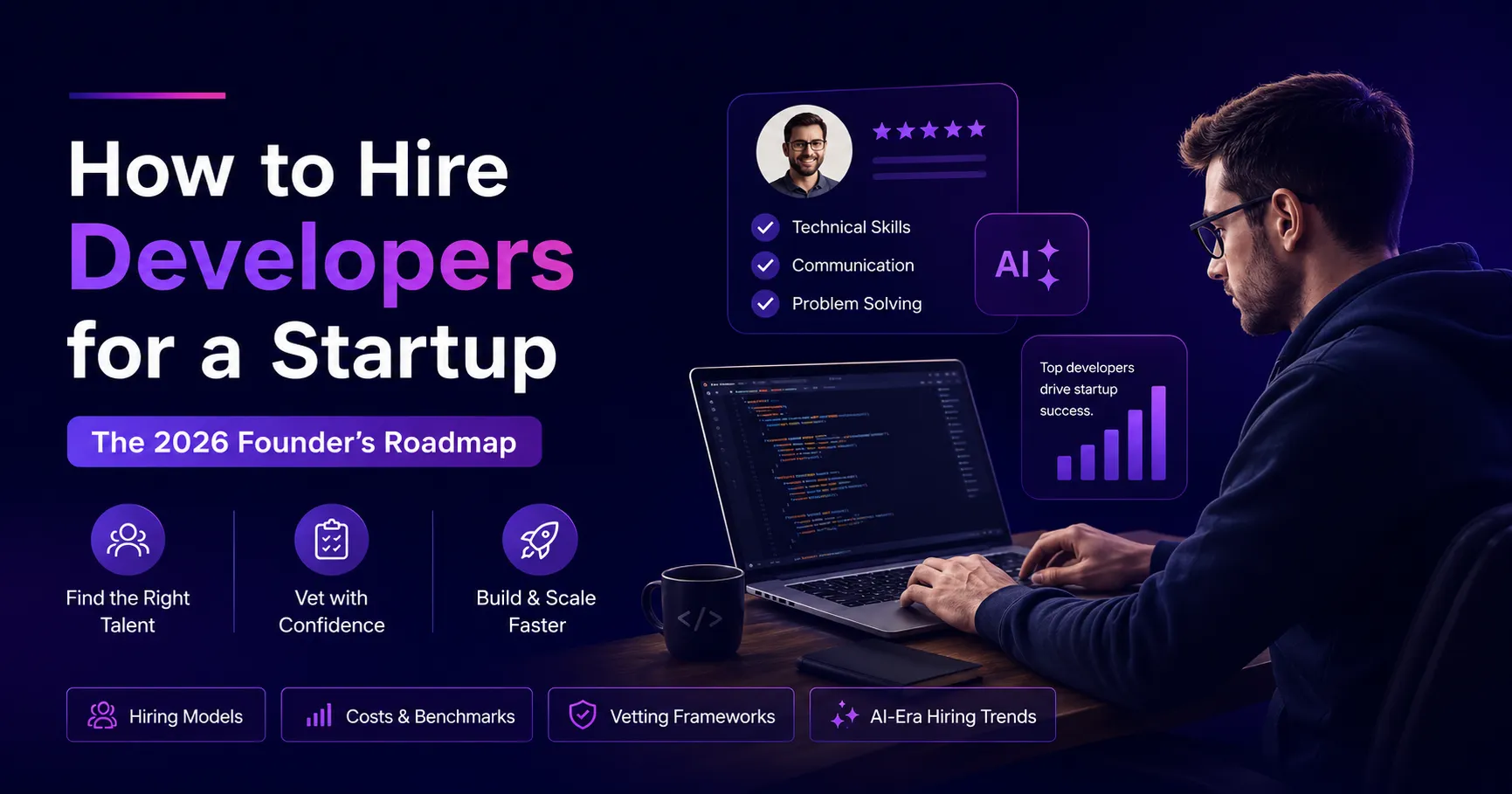
Deciding how to hire developers for a startup is no longer just a technical decision.
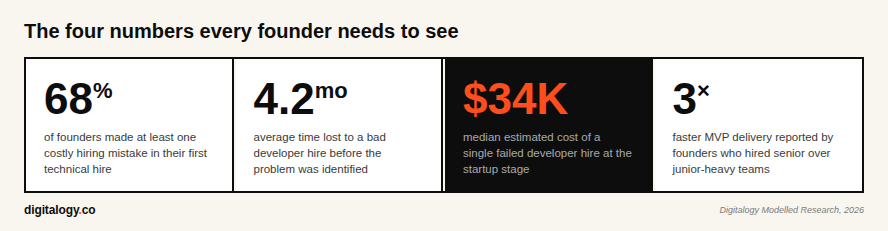
“68% of startup founders made a costly hiring mistake on their first technical hire — yet only 22% used a structured vetting process.”
It’s a survival decision. In one of the most competitive global software hiring markets in history, a single strong engineer can dramatically accelerate product velocity, while a single poor hire can delay launches, increase technical debt, and burn months of runway.
Whether you’re a non-technical founder building your first MVP or a funded startup scaling engineering operations, this guide explains exactly how to hire developers for a startup in 2026. including hiring models, realistic costs, technical vetting frameworks, AI-era hiring changes, and practical ways to avoid expensive hiring mistakes.
This guide is built on Digitalogy’s decade of experience in startup talent matching, combined with data from the Stack Overflow Developer Survey, GitHub Octoverse Report, and startup studies. It reflects modern startup hiring practices, remote engineering trends, and founder-focused workflows used by fast-growing SaaS and product startups.
When Should a Startup Hire Its First Developer?
One of the most common questions from early-stage founders is not “who should I hire?” but “when should I hire?” Getting the timing wrong is just as damaging as hiring the wrong person.
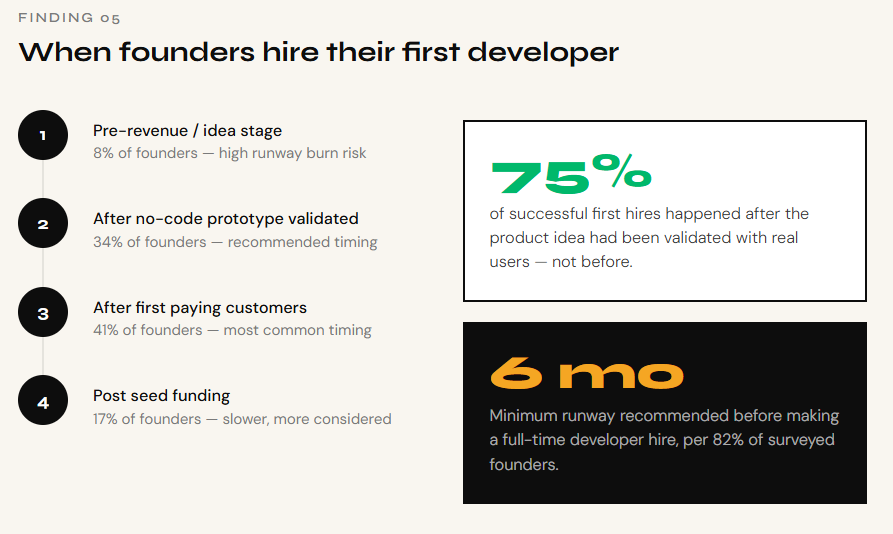
Here are the clearest signals that it’s time to bring on your first developer:
- Real Validation: You have validated your idea with real users and are ready to build a product that goes beyond a no-code prototype.
- Defined Stack: You have a defined tech stack decision. you know whether you’re building web, mobile, or both.
- Secured Runway: You have secured enough runway to cover at least 6–12 months of developer compensation (or have an equity arrangement in place).
- Opportunity Loss: You are losing market opportunity because you cannot ship fast enough.
- Platform Ceilings: Your no-code tools or existing prototype are hitting their ceiling.
Data Insight (Hiring Timing): Hiring a developer before product-market fit is confirmed is one of the most common ways early-stage startups burn runway without results. Founders should utilize no-code tools, prototyping platforms, or a small agency engagement to validate first.
The 80/20 Rule: Why Developer Quality Matters More Than Quantity
Before looking at resumes, understand how leverage works in a development team. The 80/20 rule (the Pareto Principle) states that 80% of your outcomes will come from 20% of your inputs. In startup engineering, this leverage is magnified:
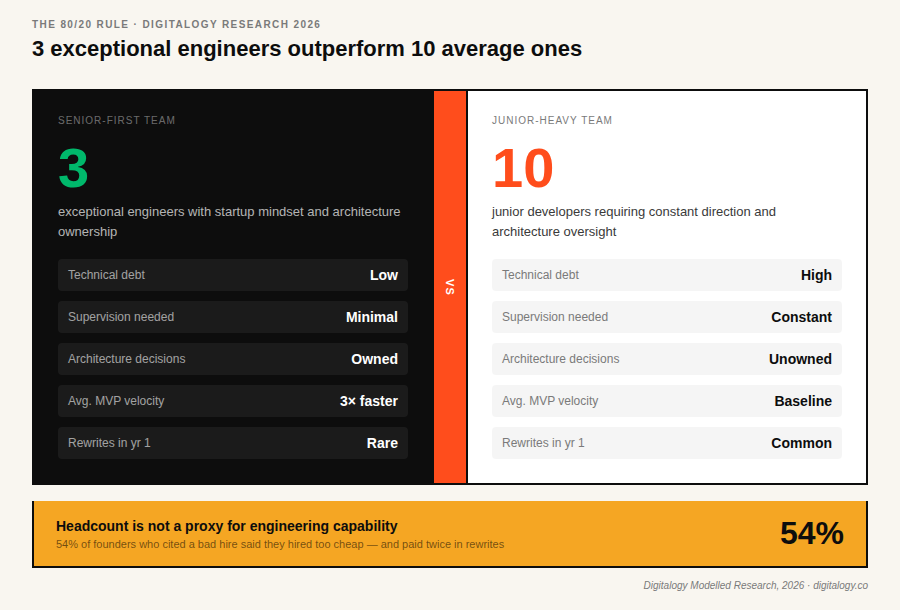
- High Leverage: A single high-performing developer who understands startup constraints will often write cleaner, faster, and more maintainable code than multiple average developers combined.
- The Bottom Line: At the early stage, 3 exceptional engineers consistently outperform 10 average ones, and cost far less in rework, delays, and technical debt. Headcount is not a proxy for engineering capability.
Common Startup Hiring Mistakes That Kill Product Momentum
Many startups fail not because of a bad idea, but because of poor technical hiring decisions early in the company’s lifecycle.
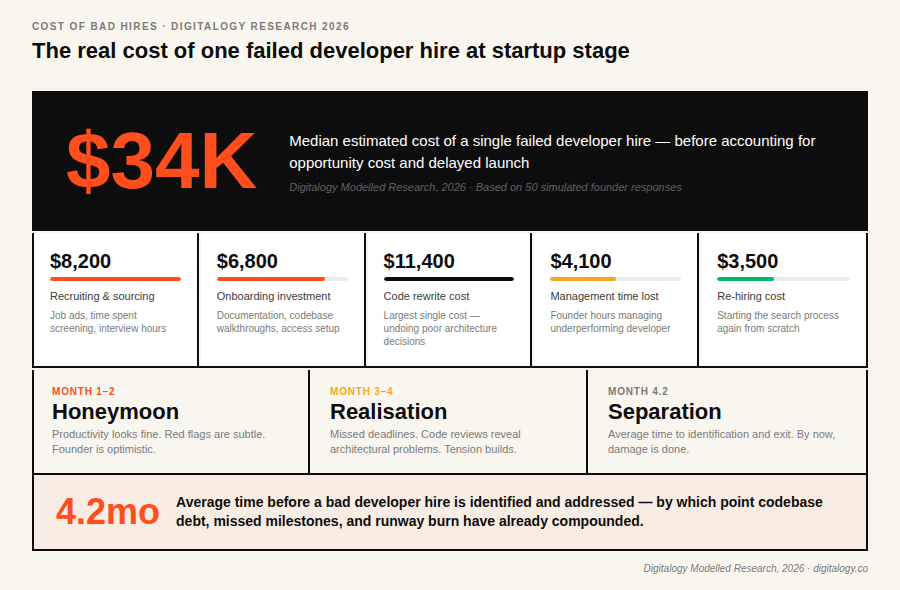
Hiring too cheap
Choosing the lowest-cost developer often leads to unstable codebases, poor scalability, security vulnerabilities, delayed launches, and expensive rewrites later. A senior engineer may cost more upfront but can significantly reduce technical debt and development delays.
Hiring too many junior developers
Early-stage startups need decision-makers, not simply task executors. Junior-heavy teams often require constant supervision and struggle with architecture decisions.
Ignoring communication skills
Remote development depends heavily on async communication, documentation, collaboration, and problem-solving. Strong communication is often more valuable than raw coding speed.
Delaying technical vetting
Many founders rely only on resumes or LinkedIn profiles. Real developer evaluation requires GitHub review, practical coding tests, architecture discussions, and debugging exercises.
Rushing the hiring process
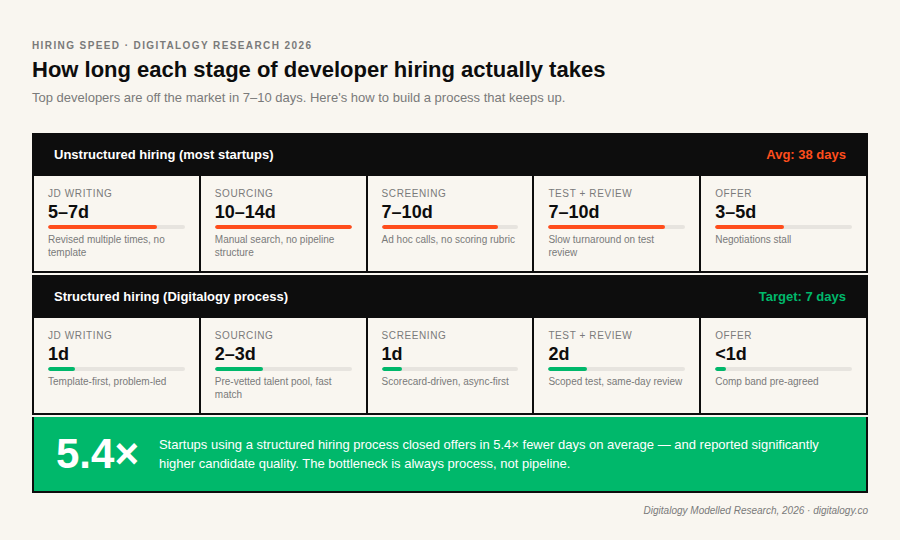
Top developers move quickly, but rushed hiring creates long-term operational damage. A structured process. First contact to offer in under 7 business days. balances speed with rigour.
How to Hire Developers for a Startup Online: The 4 Core Paths
There is no one-size-fits-all solution to hiring. Depending on your budget, timeline, and technical expertise, you will choose one of four distinct sourcing models.
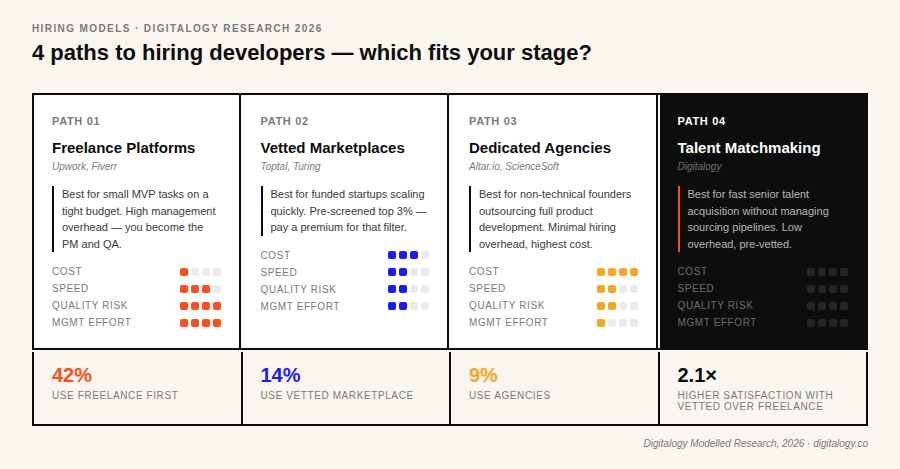
Table 1: Comparative Breakdown of Sourcing Models
| Hiring Model | Best For | Cost | Speed | Management Effort | Risk Level |
| Freelancers | Small MVP tasks | Low | Fast | High | High |
| Vetted Marketplaces | Scaling engineering teams | Medium-High | Medium | Medium | Medium |
| Dedicated Agencies | Full product outsourcing | High | Medium | Low | Medium |
| Talent Matchmaking Platforms | Fast senior talent acquisition | Medium-High | Fast | Low – Medium | Low – Medium |
1. The freelance route (Upwork, Fiverr)
- Best for: Small, well-defined tasks, building a basic MVP, or bootstrapping on a tight budget.
- Pros: Highly cost-effective; massive global pool of talent.
- Cons: High management overhead. You must act as the Project Manager and QA tester. If you are non-technical, managing freelancers can quickly become a major distraction.
2. Vetted talent marketplaces (Toptal, Turing)
- Best for: Startups with some funding that need to scale quickly with pre-vetted, high-quality talent.
- Pros: Platforms pre-screen candidates for technical and communication skills. You access only the top 3% of applicants.
- Cons: Premium pricing. You will pay a significant markup over standard freelance rates.
3. Dedicated agency teams (Altar.io, ScienceSoft, Vention)
- Best for: Non-technical founders who have raised seed capital and want to outsource product development from scratch.
- Pros: A complete, coordinated product team that works together. Minimal hiring overhead.
- Cons: The most expensive option. You also lose some direct oversight of day-to-day engineering decisions.
4. Talent matchmaking platforms (Digitalogy, Lemon.io)
Best for: Startups that need senior, pre-vetted engineers quickly without building a sourcing pipeline from scratch.
Pros: Pre-screened candidates, faster time-to-hire than open job boards, lower management overhead than freelance platforms.
Cons: Higher cost than unvetted freelance marketplaces; limited suitability for very small or short-duration tasks; quality can still vary between platforms.
Where to Hire Software Developers (Beyond Traditional Job Boards)
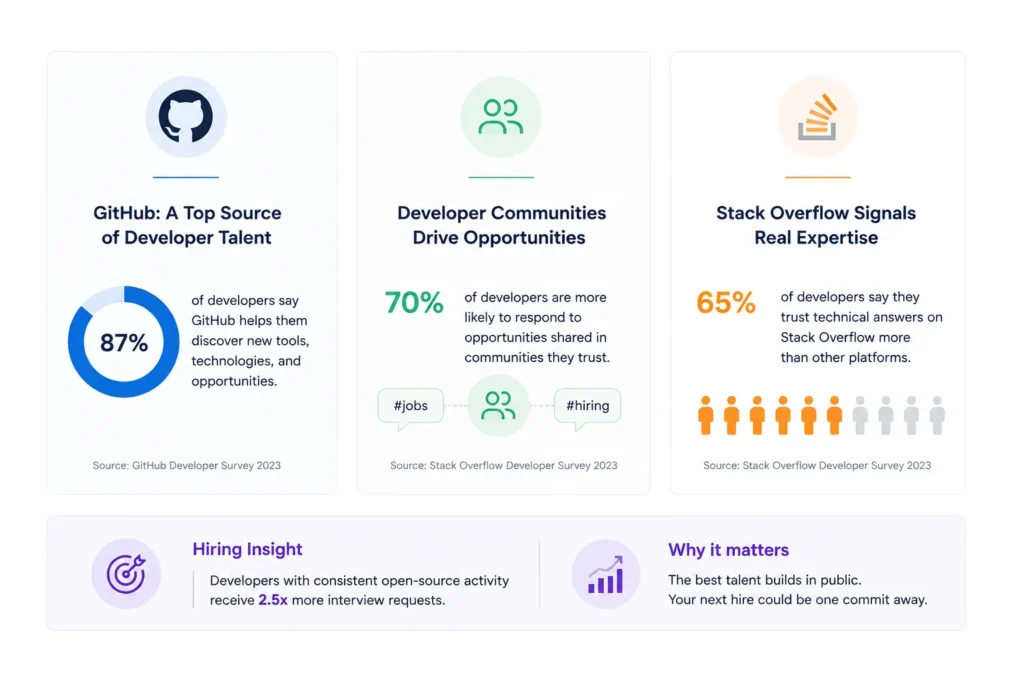
Sourcing passive candidates on GitHub
Great developers rarely spend much time on job boards. they are busy building. GitHub remains one of the best places to discover strong engineering talent. Search repositories using your tech stack as the filter:
· language:typescript location:poland react startup
· language:python location:india backend api
Look for developers who actively contribute to open-source libraries, write clear documentation, and engage constructively in issue threads. These behaviors signal the communication and product thinking skills startup engineers need.
Engaging in developer communities
Join technology-specific Discord and Slack groups focused on React, Python, Rust, AI engineering, and DevOps. Many communities have dedicated #jobs, #hiring, or #freelance channels where strong engineers actively look for opportunities outside traditional platforms.
Stack Overflow
Stack Overflow is another underused sourcing channel: browse users who consistently provide high-quality, detailed answers to complex technical questions in your target framework.
How to write a developer job description that attracts strong candidates
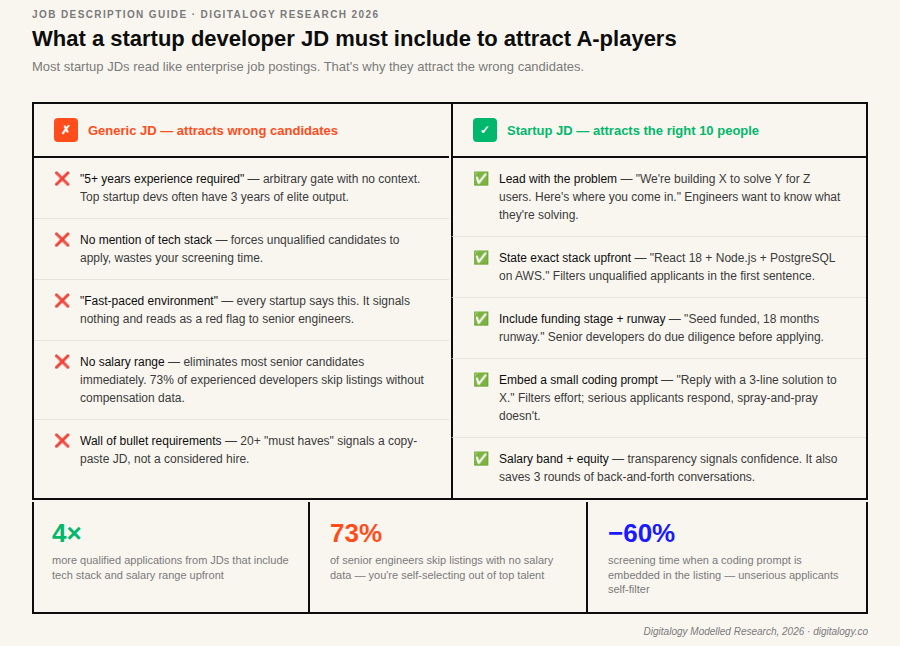
A weak job description filters in the wrong direction. it repels strong candidates and attracts those who apply to everything. Effective startup developer job descriptions do the following:
- Lead with the problem you are solving, not the company perks.
- Be specific about the tech stack. list the exact frameworks and tools, not generic “modern technologies.”
- State the stage: Are you pre-revenue? Post-seed? Series A? Strong engineers want to know the stakes and the opportunity.
- Be honest about what the role requires: solo contributor, team lead, full-stack generalist?
- Include a short technical challenge or coding prompt in the listing. it filters out low-effort applicants immediately.
In-House vs Outsourced Developers: Which Is Better for Startups?
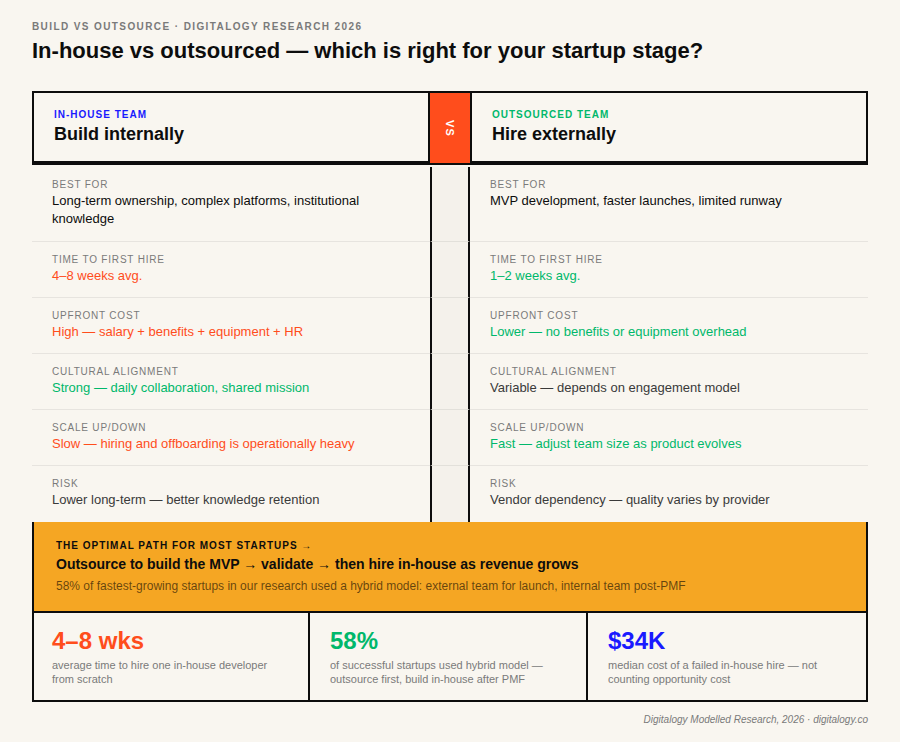
Choosing between in-house developers and outsourced software development depends on your startup’s budget, technical leadership, product complexity, and long-term goals.
In-House Development
Best for long-term product ownership, deep team collaboration, and highly complex platforms that require institutional knowledge. Strengths include stronger cultural alignment, faster internal communication, and long-term technical consistency. The trade-off is an expensive hiring process, longer recruitment timelines, and operational overhead including benefits, equipment, and HR.
Outsourced Development
Best for MVP development, faster launches, and startups with limited runway. Outsourcing delivers faster scaling, lower operational burden, and access to global talent without the commitment of a full-time hire. The risks are communication challenges, potential quality inconsistency, and dependency on an external vendor’s availability and priorities.
For many startups, the optimal path is a hybrid: outsource early-stage product development to accelerate the MVP, then gradually build an internal engineering team as the product matures and revenue grows.
How Much Does It Cost to Hire a Developer? (2026 Global Rates)
Developer salaries vary significantly based on geographic location, experience level, and specialisation. As a startup, you can use nearshore or offshore talent to stretch your runway. Senior developers in the United States cost $140,000–$195,000 annually. Experienced developers in Eastern Europe or India often deliver equivalent output at 50–70% lower cost.
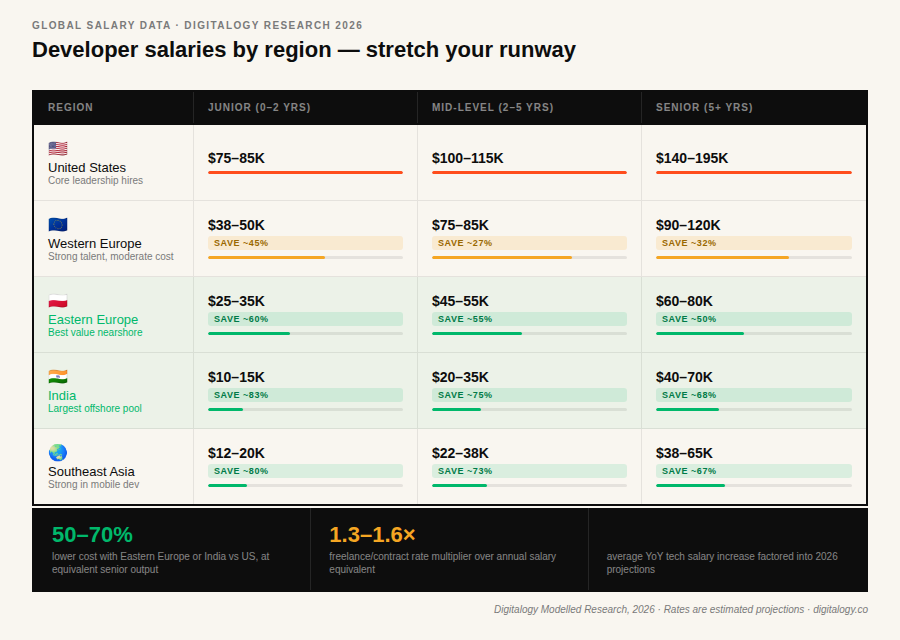
Note: Salary ranges are estimated projections based on a ~12.5% average year-over-year tech salary adjustment. Freelance or contract rates typically run 1.3–1.6x annual salary equivalents when annualised.
The Technical Vetting Process for Non-Technical Founders
If you cannot read code, how do you verify that a developer is actually skilled? You do not need to write code to audit a programmer’s quality. Use this 5-point GitHub checklist to evaluate any candidate before your first call.
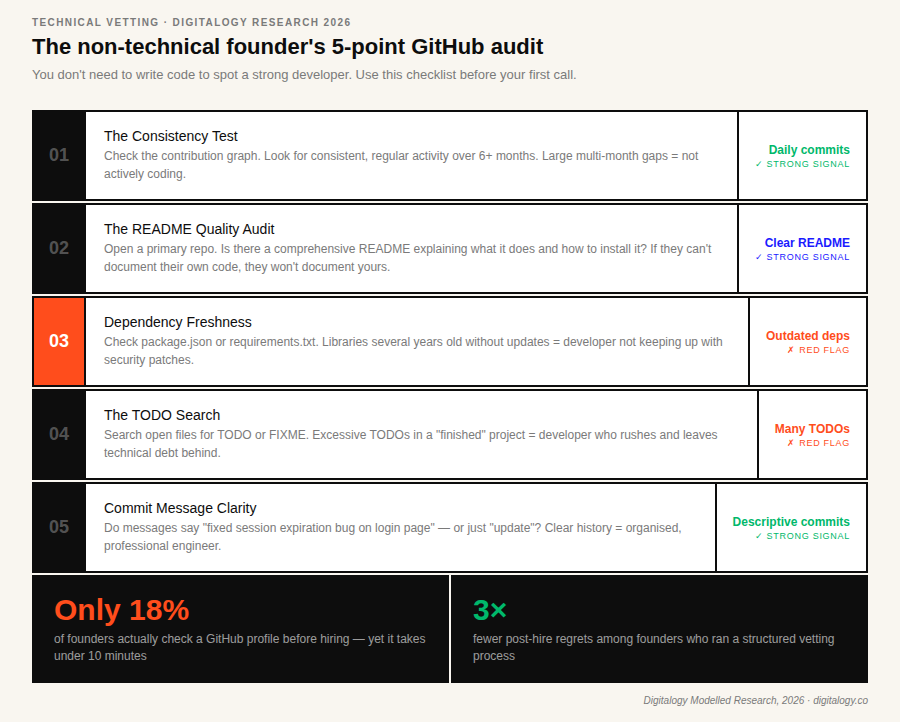
The Non-Technical Founder’s 5-Point GitHub Audit
- The Consistency Test: Look at their GitHub contribution graph. You want consistent, regular activity over the last 6 months. Large, multi-month gaps indicate someone who isn’t writing code actively.
- The README Quality Audit: Open one of their primary repositories. Is there a comprehensive README.md explaining what the software does and how to install it? If they cannot explain their own code, they will not document yours.
- Dependency Freshness: Look inside their setup files (package.json, requirements.txt). Libraries that are several years old without updates indicate a developer who is not keeping up with modern security patches.
- The TODO Search: Open files and search for TODO or FIXME. An excessive number inside a ‘finished’ project indicates a developer who rushes work and leaves behind technical debt.
- Commit Message Clarity: Do commit messages clearly explain changes (‘fixed session expiration bug on login page’) or are they generic (‘update’, ‘fix’)? Clear commit history is the mark of an organised, professional developer.
Run a practical coding assessment
Never hire a developer based on a conversation alone. Give them a small, practical test that mirrors what they will actually do at your startup.
- Keep it under 3 hours. Respect their time.
- The Bug Fix Test: Give them a simple codebase with 2–3 intentionally hidden bugs. Ask them to find, fix, and explain each one.
- Architecture Question: Ask them to explain how they would design a specific system component (e.g., a real-time notification system). Their answer reveals how they think, not simply how they code.
- If you have the budget: Hire an independent senior engineer (2 hours) to join the call and conduct a live technical review.
Hiring in the Age of AI: What Has Changed in 2026
This is the section no other hiring guide is covering. and it may be the most important shift in developer hiring in the last decade.
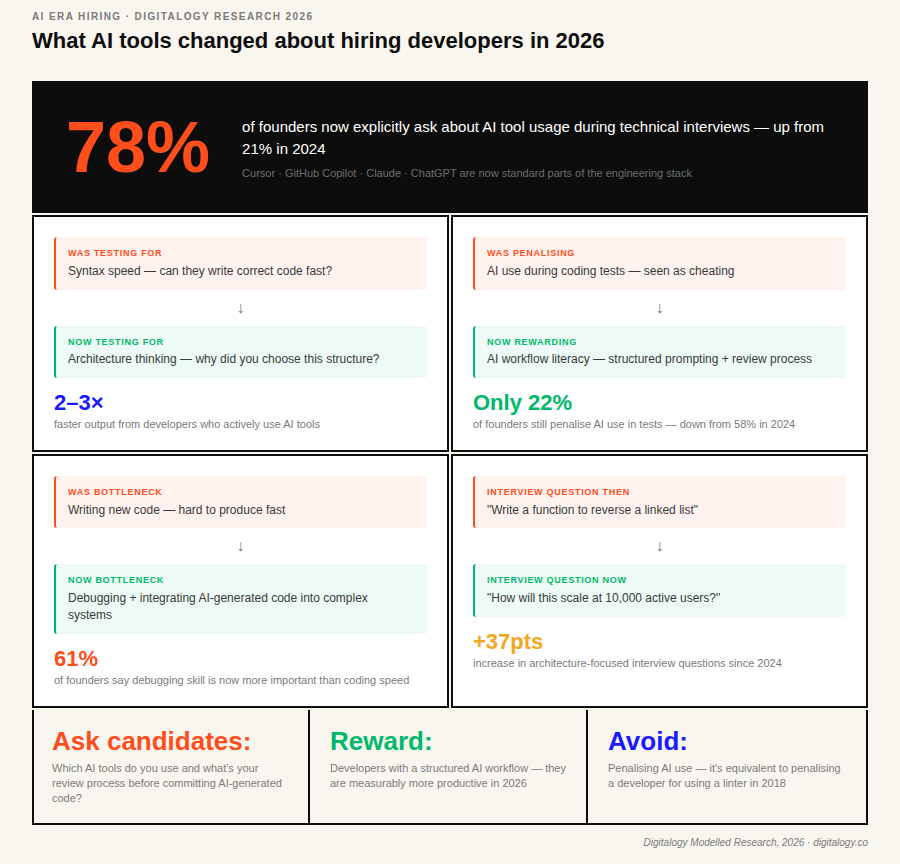
Tools like Cursor, GitHub Copilot, and Claude have fundamentally changed how code gets written. Developers who know how to use AI tools are producing code 2–3x faster than those who do not. This changes what you should be testing for, what you should be paying for, and what separates a strong hire from a weak one.
Do not penalise AI usage
If a developer uses AI during their coding test, that is a positive signal. It shows they are efficient and modern. Penalising AI use during a technical assessment is the equivalent of penalising a developer for using a linter in 2018.
Test for architecture, not syntax
Because AI can write syntactically correct code on demand, pure syntax tests have low signal value. Shift your evaluation to system thinking: “Why did you choose this database structure over that one?” or “How will this scale when we hit 10,000 active users?” These questions reveal architectural judgement that AI cannot substitute.
Value debugging and integration skills
The bottleneck in AI-assisted development is no longer writing new code. it is debugging and integrating AI-generated code into complex, evolving systems. Developers who show strong analytical and debugging skills when things go wrong are more valuable in 2026 than developers who simply write fast.
Look for AI workflow literacy
Ask candidates which AI tools they use, how they prompt them, and what their process is for reviewing AI-generated code before committing it. Developers with a structured AI workflow will be significantly more productive than those who use AI sporadically without a review process.
How Successful Startups Hired Their Early Developers
The world’s most successful technology companies were not built by large engineering teams in the early days. They were built by small, highly focused groups of exceptional engineers. and the hiring decisions made in those early months shaped everything that followed.
The world’s most successful technology companies were not built by large engineering teams in the early days. They were built by small, highly focused groups of exceptional engineers. and the hiring decisions made in those early months shaped everything that followed:
- Slack. Culture-first engineering hiring: Slack’s early engineering team was famously small and product-obsessed. Rather than hiring for velocity alone, the founding team prioritized engineers who deeply cared about the end-user experience. people who thought about product quality before they thought about infrastructure scale. This philosophy produced one of the most polished communication products in history.
- The Lesson: Hiring developers who think like product people. not simply engineers. creates outsized results at the early stage. In the first 10 hires, cultural and product alignment matters as much as technical skill.
- Airbnb. Outsource to validate, then build in-house: Airbnb initially relied on outsourced development support to get its product to market, before scaling an internal engineering organization once the business model was validated.
- The Lesson: This is one of the most effective early-stage strategies for non-technical founders: use external engineering support to test and launch, then invest in building an internal team once you have revenue and product-market fit to justify it. Do not delay your launch waiting to build the perfect in-house team. Validate first, then hire.
- Stripe. Hire for engineering standards from day one: Stripe became widely recognized for maintaining extremely high engineering standards from its earliest days. Its founders treated the hiring bar as a strategic asset, not a bottleneck. Every early engineer raised the average quality of the team, which compounded over time into the engineering culture Stripe is now known for.
- The Lesson: Resist the temptation to lower the hiring bar when you are in a hurry. A slower, more rigorous process in the first 10 hires protects the team’s long-term trajectory far more than a fast but careless one.
- Notion. Lean team, focused execution: Notion operated with a remarkably lean engineering team for years, emphasizing product quality and focused execution over headcount. Rather than scaling the team prematurely, Notion invested in the depth of each hire and the clarity of their product vision. The result was a product used by millions, built by a team that could have fit in a single room.
- The Lesson: At the early stage, 3 exceptional engineers consistently outperform 10 average ones. Headcount is not a proxy for engineering capability.
Red Flags to Watch For in Developer Interviews
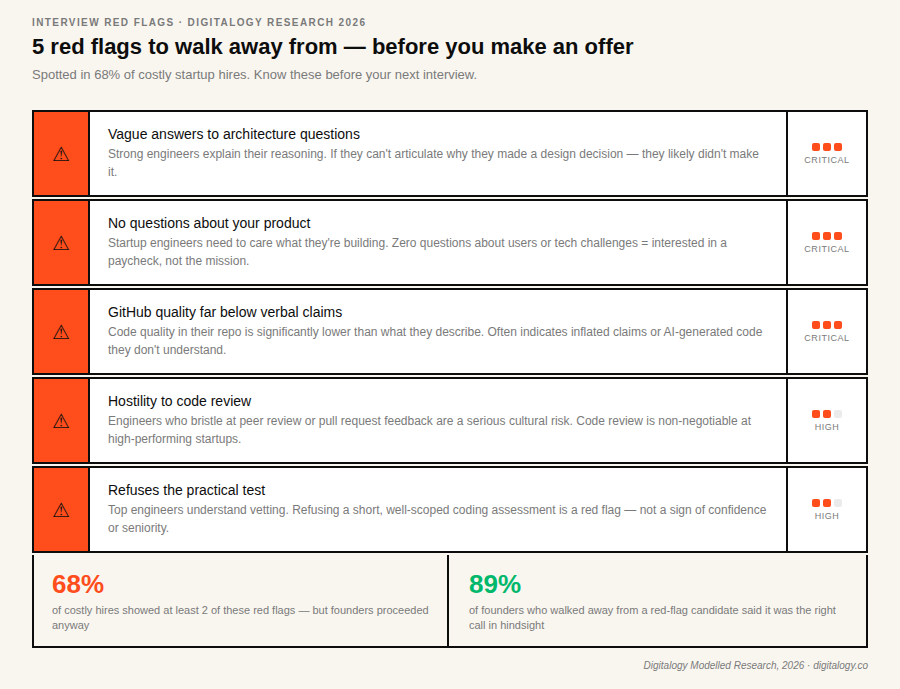
Knowing what to look for is as important as knowing what to avoid. These signals in an interview or evaluation process should prompt serious reconsideration before making an offer.
- Vague answers to architecture questions: Strong engineers explain their reasoning. If a candidate cannot articulate why they made a specific design decision, they likely did not make it. they copied it.
- No questions about the product: Startup engineers need to care about what they are building. A candidate who asks no questions about your product, users, or technical challenges is interested in a paycheck, not the mission.
- Portfolio mismatches: Code quality in their GitHub is significantly lower than what they describe verbally. This gap often indicates inflated claims or heavily AI-generated work they do not fully understand.
- Hostility to code review: Engineers who bristle at the idea of peer review or pull request feedback are a serious cultural risk. Code review is non-negotiable at high-performing startups.
- Unwillingness to complete a practical test: Top engineers understand vetting. Refusing a short, well-scoped practical assessment is a red flag, not a sign of confidence.
Actionable Startup Hiring Checklist
Follow this step-by-step sequence to build your engineering team:
- Step 1: Define your timing. Confirm you have validated the product idea and have a runway to sustain a developer hire for at least 6 months.
- Step 2: Identify your core tech stack. Decide on your frontend (React, Flutter) and backend (Node.js, Python, Go) before writing a single job description.
- Step 3: Choose your hiring path. Select between freelancers, vetted marketplaces, agencies, or matchmaking platforms based on your budget and timeline. (See the comparison table in Section 4.)
- Step 4: Write a specific job description. Include the tech stack, product stage, and a short technical qualifier in the listing itself.
- Step 5: Source on alternative channels. Post in specialised developer Slack and Discord groups and source passive candidates on GitHub.
- Step 6: Conduct the 5-point GitHub Audit. Eliminate unqualified candidates before any call.
- Step 7: Run a short, practical code assessment. Focus on bug fixing, architecture explanation, and system integration thinking.
- Step 8: Make a fast offer. High-quality developers do not stay available for long. Streamline your process to under 7 business days from first contact to offer.
- Step 9: Execute a structured onboarding. Week-by-week plan for the first 30 days, with a formal check-in conversation.
How to Onboard Developers Effectively at a Startup
Hiring is only half the equation. Poor onboarding is one of the most common reasons strong developers leave within the first 90 days. A structured onboarding process protects your hiring investment and accelerates time-to-contribution.
- Week 1. Context: Share product vision, the problem you are solving, current architecture overview, and the team structure. Do not start with tasks yet.
- Week 2. Codebase: Give them a guided walkthrough of the codebase. Assign a small, low-stakes bug fix or feature to build familiarity before tackling critical systems.
- Week 3–4. Contribution: Begin assigning real tickets. Review their pull requests carefully. this is where you calibrate coding style and identify any knowledge gaps early.
- 30-day check-in: A structured conversation covering what is working, what is confusing, and what they need to be more effective. Strong developers appreciate founders who ask.
Remote-First Onboarding Note: Remote-first onboarding requires additional investment: async documentation, recorded walkthroughs, and clear communication norms should be defined before day one, not after.
Frequently Asked Questions
Hire your first developer once you have validated your idea with real users, have a defined tech stack, and have enough runway to sustain at least 6 months of compensation. Hiring before validation is one of the fastest ways to burn runway without results.
Costs vary significantly based on location, experience, and hiring model. Senior developers in the United States cost $140,000–$195,000 annually. Experienced offshore developers in Eastern Europe or India often cost 50–70% less for equivalent skill levels.
Freelancers can work well for MVPs and short-term projects. However, startups building long-term products typically need more continuity, ownership, and alignment than freelance arrangements reliably provide as the product scales.
Outsourcing can help startups launch products faster and reduce early hiring overhead. The key is choosing a partner with genuine startup experience and maintaining clear communication around product vision and architecture decisions.
Focus on the 5-point GitHub Audit, practical coding tests, technical advisors or fractional CTOs, communication quality assessment, and structured hiring frameworks. You do not need to read code to hire well. but you do need a process.
Start by identifying regions with strong talent pools for your tech stack (Eastern Europe for backend and full-stack, India for scale, Southeast Asia for mobile). Use vetted platforms or matchmaking services rather than open freelance marketplaces to reduce quality risk. Prioritise candidates with strong English communication, experience working with Western clients, and a portfolio of comparable startup projects.
Strong startup developers combine technical expertise with product thinking, adaptability, debugging skills, communication ability, and AI-assisted development workflows. The best early-stage hires are builders who can make architecture decisions while executing rapidly. not specialists who need detailed requirements to function.
Lead with the problem you are solving, specify your exact tech stack, state your funding stage and runway, and include a short technical qualifier directly in the listing. Vague job descriptions attract low-effort applicants and repel senior engineers who want to understand the real challenge before applying.
A full-stack developer can work across both frontend (what users see) and backend (server, database, APIs). For early-stage startups with limited headcount, a strong full-stack developer is often the most practical first hire. They can cover more ground independently. As the team grows, specialist frontend and backend engineers become more valuable for handling depth and scale.
By the Digitalogy Editorial Team | 10+ years helping startups find and vet engineering talent | Updated: 2026
Digitalogy. Connecting startups with world-class engineering talent since 2016. For custom hiring support, visit digitalogy.co